


Updated Date: 07/07/2026
Visual Policy Editor Concepts
The visual policy editor is a screen on which to configure a per-session policy (also known as an access policy) or a per-request policy using visual elements.
This table provides a visual dictionary for the visual policy editor.
| Visual element | Element type | Description |
|---|---|---|
| alt=“Green Start icon”> |



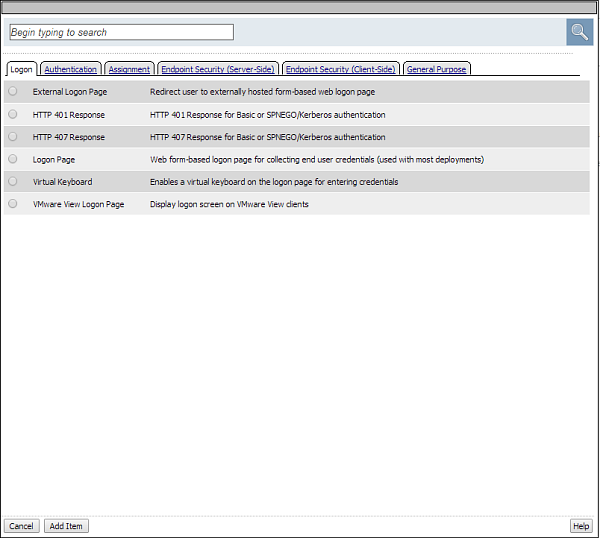
The actions that are available on any given tab of the add item screen depend on the access profile type, such as LTM-APM (for web access) or SSL-VPN (for remote access), and so on. Only actions that are appropriate for the access profile type will display.
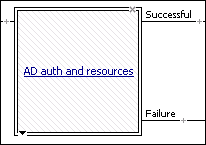
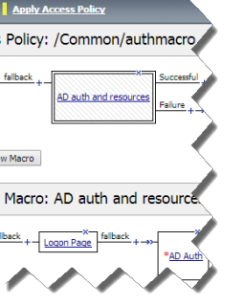
A macro is a collection of access policy actions that provide common access policy functions. For example, AD auth and resources is a preconfigured macro template. It supplies a logon page, an Active Directory authentication action, and a resource assignment action. The properties and rules for the actions are configurable.
After a macro is configured, it can be placed into the access policy by adding a macrocall. A macrocall is an action that performs the functions defined in a macro.
A macro contains actions and terminals and can include macrocalls.
Note: You cannot use subroutines in macros within per-request policies.
- Access policy actions
- Any available action or series of actions.
- Macrocalls
- Calls to other macros (nested macros).
- Terminals
- An endpoint in a macro. Default terminals are Successful and Failure. Terminals are configurable and can be added and deleted.
Terminals defined in the macro display as the branches that follow the macrocall after it has been added to the access policy.
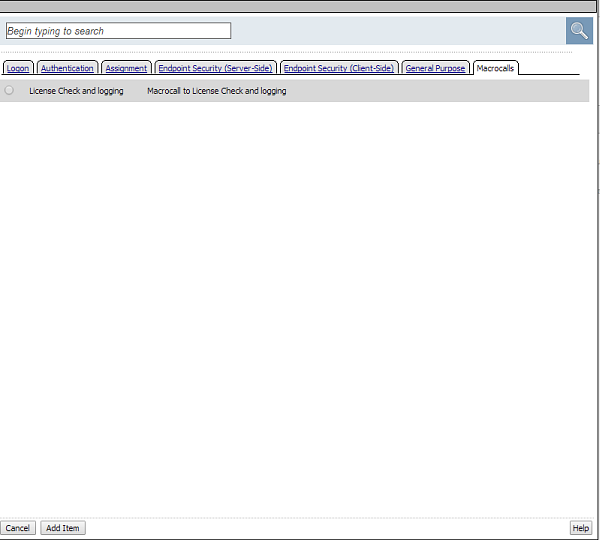
The Macrocalls tab displays when one or more macros has been added for use in the access policy. When adding an access policy item to a macro, the Macrocalls tab displays unless adding a macrocall would create a misconfiguration, such as causing a macro loop or causing a series of macrocalls to exceed a depth of three.
Note: Macrocalls can be added to any access policy. Macrocalls cannot be shared across access policies.
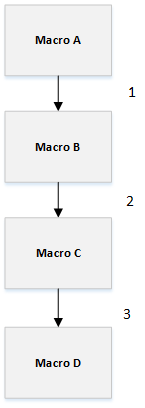
In an access policy, a macro can make a macrocall to another macro until up to three macros have been called in series.
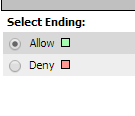
An ending provides a result for an access policy branch. An ending for an access policy branch can be one of three types.
- Allow
- Starts the SSL VPN session and loads assigned resources and a webtop, if assigned, for the user. Typically, you assign this when the user passes specific checks.
- Deny
- Disallows the SSL VPN session and shows the user an access denied web page. Typically, you assign this when the user does not have access to resources, or fails authentication. Alternatively after a session starts, shows a URL filter denied web page after a per-request policy rejects a request for a URL.
- Redirect
- Redirects the client to the URL specified in the ending configuration. You can define a redirect URL for each redirect ending. Typically, you can assign a redirect when the user requires remediation or a separate resource. For example, a user who fails the antivirus check because virus definitions are out of date can be redirected to the software manufacturer’s site to get an antivirus update.
The maximum size for an expression in the visual policy editor is 64 KB. The visual policy editor cannot save an expression that exceeds this limit.
Access Policy Manager (APM) provides two types of policies.
- Per-session policy
- The per-session policy runs when a client initiates a session. (A per-session policy is also known as an access policy.) Depending on the actions you include in the access policy, it can authenticate the user and perform other actions that populate session variables with data for use throughout the session.
- Per-request policy
- After a session starts, a per-request policy runs each time the client makes an HTTP or HTTPS request. Because of this behavior, a per-request policy is particularly useful in the context of a Zero Trust scenario, where the client requires re-verification on every request. A per-request policy can include a subroutine, which starts a subsession. Multiple subsessions can exist at one time.
Note: You cannot use subroutines in macros within per-request policies.
You can associate one access policy and one per-request policy with a virtual server.
The Apply Access Policy link has no effect on a per-request policy. Conversely, updates made to a per-request policy do not affect the state of the Apply Access Policy link.
Access Policy Manager® (APM®) supports calling a macro from a per-request policy and calling a subroutine macro from a per-request policy subroutine. However, APM does not support calling any type of macro from a per-request policy macro or from a per-request policy subroutine macro.
A per-request policy subroutine is a collection of actions. What distinguishes a subroutine from other collections of actions (such as macros), is that a subroutine starts a subsession that, for its duration, controls user access to specified resources. If a subroutine has an established subsession, subroutine execution is skipped. A subroutine is therefore useful for cases that require user interaction (such as a confirmation dialog or a step-up authentication), since it allows skipping that interaction in a subsequent access.
Note: You cannot use subroutines in macros within per-request policies.
Subroutine properties specify subsession timeout values, maximum macro loop count, and gating criteria. You can reauthenticate, check for changes on the client, or take other actions based on timeouts or gating criteria.
A subsession starts when a subroutine runs and continues until reaching the maximum lifetime specified in the subroutine properties, or until the session terminates. A subsession populates subsession variables that are available for the duration of the subsession. Subsession variables and events that occur during a subsession are logged.
Multiple subsessions can exist at the same time. The maximum number of subsessions allowed varies across platforms. The total number of subsessions is limited by the session limits in APM (128 * max sessions). Creating a subsession does not count against the license limit.
You can access all of the BIG-IP system documentation from the AskF5 Knowledge Base located at https://support.f5.com/.
| Document | Description |
|---|---|
| BIG-IP Access Policy Manager: Application Access | This guide contains information for an administrator to configure application tunnels for secure, application-level TCP/IP connections from the client to the network. |
| BIG-IP Access Policy Manager: Authentication Essentials | This guide contains information to help an administrator understand authentication concepts, such as AAA server, SSL certificate, local user database, and so on. |
| BIG-IP Access Policy Manager: Authentication Methods | This guide contains information describes different types of authentication, including Active Directory, LDAP and LDAPS, RSA SecurID, RADIUS, OCSP, CRLDP, Certificate, TACACS+, and so on. |
| BIG-IP Access Policy Manager: OAuth Concepts and Configuration | This guide describes OAuth concepts and explains how to configure the system to use OAuth authorization servers, resource servers, and other examples. |
| BIG-IP Access Policy Manager: SAML Configuration | This guide introduces SAML concepts and provides several examples using APM as a SAML IdP, as a SAML service provider, and others. |
| BIG-IP Access Policy Manager: Single Sign-On Concepts and Configuration | This guide describes how to configure different types of single sign-on methods, such as HTTP basic, HTTP forms-based, NTLMV1, NTLMV2, Kerberos, OAuth Bearer. |
| BIG-IP Access Policy Manager: Customization | This guide provides information about using the APM customization tool to provide users with a personalized experience for access policy screens, and errors. An administrator can apply your organization’s brand images and colors, change messages and errors for local languages, and change the layout of user pages and screens. |
| BIG-IP Access Policy Manager: Edge Client and Application Configuration | This guide contains information for an administrator to configure the BIG-IP system for browser-based access with the web client as well as for access using BIG-IP Edge Client and F5 Access Apps. It also includes information about how to configure or obtain client packages and install them for BIG-IP Edge Client for Windows, Mac, and Linux, and Edge Client command-line interface for Linux. |
| BIG-IP Access Policy Manager: Implementations | This guide contains implementations for synchronizing access policies across BIG-IP systems, hosting content on a BIG-IP system, maintaining OPSWAT libraries, configuring dynamic ACLs, web access management, and configuring an access policy for routing. |
| BIG-IP Access Policy Manager: Network Access | This guide contains information for an administrator to configure APM Network Access to provide secure access to corporate applications and data using a standard web browser. |
| BIG-IP Access Policy Manager: Portal Access | This guide contains information about how to configure APM Portal Access. In Portal Access, APM communicates with back-end servers, rewrites links in application web pages, and directs additional requests from clients back to APM. |
| BIG-IP Access Policy Manager: Secure Web Gateway | This guide contains information to help an administrator configure Secure Web Gateway (SWG) explicit or transparent forward proxy and apply URL categorization and filtering to Internet traffic from your enterprise. |
| BIG-IP Access Policy Manager: Third-Party Integration | This guide contains information about integrating third-party products with Access Policy Manager (APM). It includes implementations for integration with VMware Horizon View, Oracle Access Manager, Citrix Web Interface site, and so on. |
| BIG-IP Access Policy Manager: Visual Policy Editor | This guide contains information about how to use the visual policy editor to configure access policies. |
| Release notes | Release notes contain information about the current software release, including a list of associated documentation, a summary of new features, enhancements, fixes, known issues, and available workarounds. |
| KB articles | Knowledge base articles are responses and resolutions to known issues, additional configuration instructions, and how-to information. |