


Updated Date: 06/30/2026
New Features in this Version
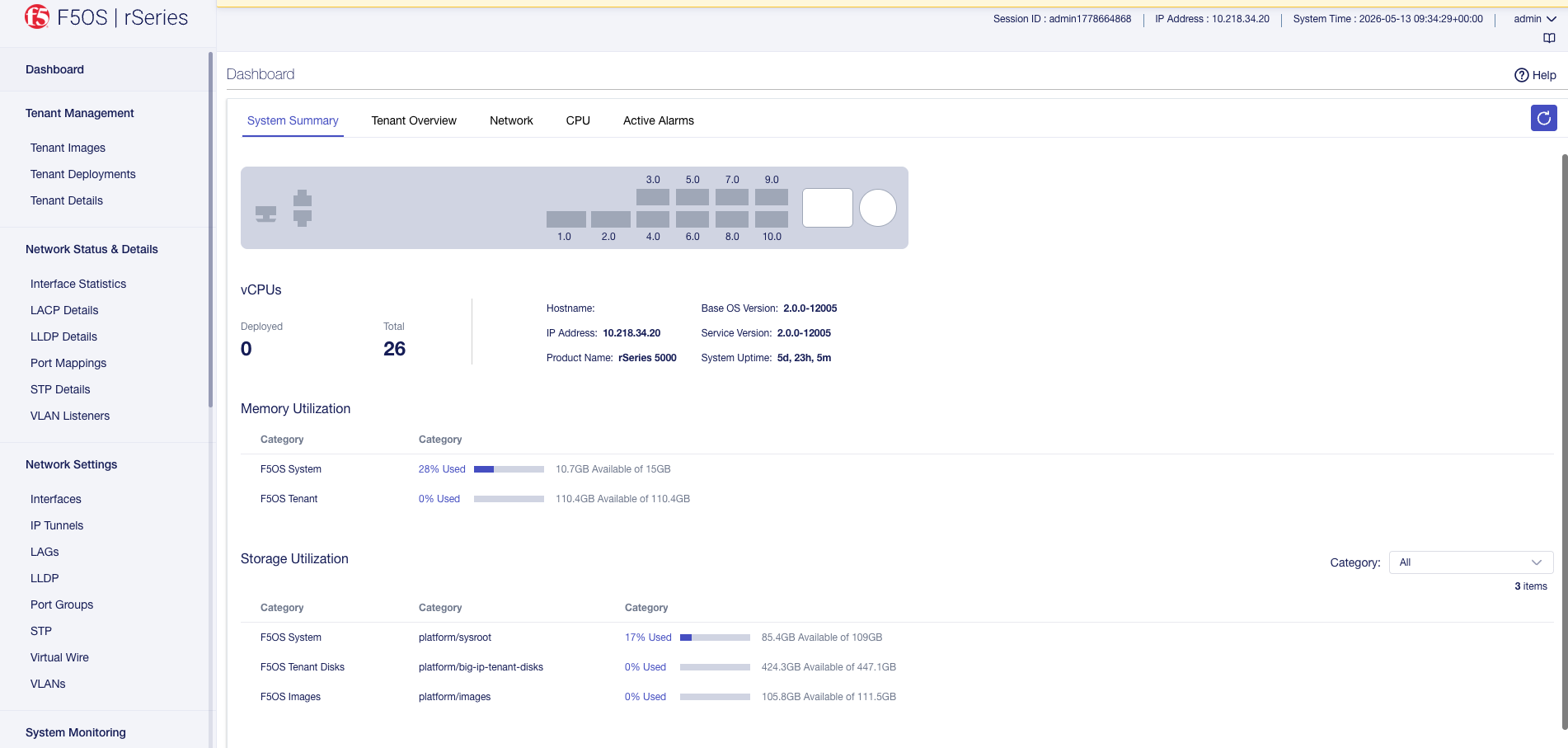
The latest webUI enhancement represents a significant refactoring from the previous version, offering a more modern and intuitive user experience. Key improvements include:
- Unified webUI experience: Consistent user experience across all F5 products.
- Refined interface: A polished design that enhances overall aesthetics and usability.
- Improved navigation: Enhanced navigation features that make it easier for users to find and access the tools they need.
- Optimized workflows: Streamlined processes that reduce complexity and improve efficiency.
- Cleaner layout: A simplified layout that promotes clarity and ease of use.
- Enhanced tool clarity: Critical functions are now more accessible and efficiently organized, enabling users to work with greater precision and productivity.
F5OS v2.0 introduces Zero Touch Provisioning (ZTP) that automates the software installation and base configuration setup for F5 rSeries devices, reducing the need for manual intervention.
ZTP simplifies operations in F5 rSeries Devices for the following situations:
-
Setting up a new F5 rSeries device: ZTP can update the F5OS software and apply an initial configuration for the new device.
-
Re-provisioning F5 rSeries: Re-enabling ZTP on the device can allow for automatic retrieval of configuration settings not previously set and provision an updated software version of F5OS.
-
Upgrading the system software: When deploying multiple F5 rSeries devices in a large-scale environment, ZTP can be set up to preinstall the most up-to-date software version during the provisioning process.
F5OS v2.0 introduces advanced foreground diagnostic features designed to optimize system monitoring, streamline troubleshooting, and enhance overall reliability on F5 rSeries platforms. This feature allows you check the health of hardware components such as CPU, memory, and disk while the system is running, without taking tenants offline. Foreground diagnostics improve fault isolation and help reduce “No Trouble Found” (NTF) outcomes before a Return Merchandise Authorization (RMA) is approved. You can start, stop, and run diagnostic profiles, and view results including run state, pass/fail outcome, and execution duration from the CLI, webUI, or REST API.
F5OS v2.0 supports following security protocols for SNMPv3:
- SHA256, and SHA512 for authentication to ensure data integrity and secure access.
- AES192, and AES256 for encryption to protect communication and ensure data confidentiality.
This release introduces traffic monitoring capabilities on management ports. You can now effectively analyze packets transmitted and received through the management port. This helps in identifying and resolving network issues such as connectivity problems, misconfigurations, or unauthorized access in a more efficient and timely manner.
F5OS v2.0 support static route configuration on the F5OS management network interface. This enhancement enables you to define custom routes to direct management traffic based on destination IPs or networks using the CLI and Rest API.
F5 r5000/r10000/r12000 platforms now support tagging Management VLAN on the Always-On Management (AOM) interface. This feature ensures that network administrators now have enhanced control and ease of access when managing VLAN configurations for their systems. This feature enables you to configure and tag the Management VLAN directly using the ConfD CLI, Rest API, and on the AOM menu.
This feature enables you to create VLANs for management interfaces. You can configure the management VLANs through from both ConfD CLI and webUI. These VLANs effectively segregate management traffic, thereby improving network security and stability. For example, with management VLANs, you can:
- Separate tenants on different VLANs to improve security and maintain clear security zones within the same appliance.
- Manage IP addresses more effectively.
F5OS v2.0 allows you to enable or disable specific TLS versions and SSL ciphers. You can also view a list of all allowed ciphers and TLS versions for your F5OS deployment. This gives you more control over your security settings and helps you meet your organization’s compliance requirements. F5OS v2.0 support for both TLS v1.2 and TLS v1.3 cipher suites and must be configured individually on the management network.
F5OS v2.0 adds support for Bcrypt (Blowfish-based encryption) as an optional method for encrypting stored passwords. This feature is opt-in and requires a configuration change to enable. After you enable Bcrypt encryption, only passwords that are refreshed or changed from that point forward are stored using the new encryption method. Existing passwords remain unchanged until you update them.
You can now check whether a license being installed is a FIPS license before applying it, using the new system licensing check-install CLI command.
When switching between a FIPS license and a non-FIPS license, the system warns that a secure-erase operation will be performed. This operation irreversibly destroys all partitions, deletes all tenants, and triggers a system reboot.
F5OS authentication supports many-to-one mappings between LDAP groups and F5OS roles. You can assign multiple LDAP groups to a single role. This simplifies role management and ensures consistent permissions across user groups.
LDAP authentication now supports OpenLDAP servers that don’t use posixAccount. You can use alternative attributes, such as object class, for authentication. This enhancement ensures broader compatibility across diverse directory schemas.
-
BIG-IP tenants with version v17.1.x, v17.5.x, and v21.x are supported on the F5OS v2.0.
-
For information about supported tenants on F5 rSeries platforms, see the F5 rSeries hardware products section of the F5 hardware/software compatibility matrix.
F5OS v2.0 introduces enhanced cloud-init functionality for tenant creation and BIG-IP instance initialization using user-data. Cloud-init reads the provided configuration data, commonly referred to as user-data, and processes it to apply the necessary system setup.
F5 r5000/r10000/r12000 series platforms with v2.0 now supports Q-in-Q VLAN tagging (IEEE 802.1ad), also known as double tagging. Q-in-Q VLAN tagging lets you add a service tag (S-tag) to packets that already have a customer tag (C-tag). This feature is designed for service provider edge roles where you need to isolate customer traffic across a shared backbone network.
You can use subinterfaces to define multiple Q-in-Q tagging rules on a single physical interface. Each subinterface maps a specific C-tag to an S-tag. This lets you handle multiple VLAN mappings on one port without dedicating separate physical interfaces to each, keeping traffic logically isolated while reducing the number of ports you need.
Note: This feature requires the latest field-programmable gate array (FPGA) bitfiles that support double tag handling.
- F5 rSeries: r5000, r10000, and r12000.
F5OS v2.0 enables you to configure Round Robin DAG (RR-DAG) on a F5 BIG-IP tenant to specify per protocol basis. This feature is available for BIG-IP tenants running on the following platforms:
- F5 r5000 series
- F5 r10000 series
- F5 r12000 series
Note: You must enable RRDAG on the BIG-IP system before you can configure it for a specific port.
F5 r5000/r10000/r12000 series platforms now supports an extra-large (XL) MAC address pool size, allowing up to 96 MAC addresses to be allocated to a single F5 BIG-IP tenant. Allocating an XL MAC address pool to one tenant reduces the MAC addresses available for other BIG-IP tenants on the same system.
- Enhanced logging for critical services: F5OS v2.0 release improves system logging for critical services. After you upgrade, you may notice more detailed entries in your extended error logs. To see the updated entries, you must reload the affected services in your infrastructure.
- You can view information about the cluster and firmware install status under the Controller Management section.
- You can use the new CLI command to display system software install data, which includes the OS version, service version, cluster, and firmware install version.
- Support for many-to-one LDAP group-to-role mappings has been implemented. This enables multiple LDAP groups to be assigned to a single F5OS role, ensuring that users belonging to any configured group are granted the corresponding role upon login.