


Updated Date: 07/07/2026
Dashboards
The VELOS system dashboards display relevant system information when you log in to the system controller or chassis partition webUI.
F5OS webUIs fully support the latest versions of Chrome and Firefox browsers at the time of each F5OS release.
Both of the dashboards are divided into sections that show:
- Chassis partition details
- System controller information
- High availability status
- Tenant information
- Network information
- CPU data
- Active alarms
The system controller dashboard shows information about which slots have blades in them, how the chassis is divided into chassis partitions, system summary information, system controller high availability status, CPU data, and active alarms. It displays when you log in to the system controller webUI or click DASHBOARD from any other area in the system controller webUI. If a message of the day (MOTD) has been configured, it will display immediately upon login.
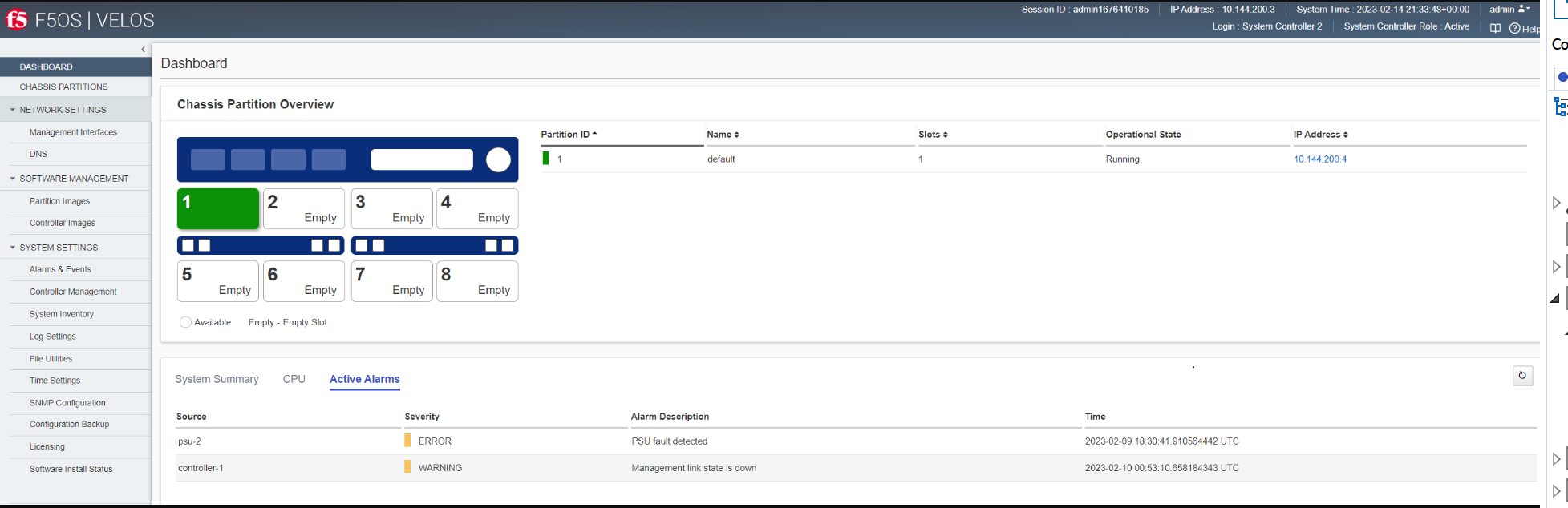
This system has a blade in slot 1. The default chassis partition is running on that slot. Slots 2 through 8 are empty.
The Chassis Partition Overview section shows a graphical view of the chassis. Chassis partition details on the system controller dashboard show an overview of all the chassis partitions. The chassis partition dashboard shows details about the chassis partition to which you are logged in.
The slots associated with the default chassis partition are shown in green. The table on the right displays chassis partitions details. Click the IP address of an active chassis partition to log in directly to the chassis partition.
The system controller dashboard also includes these sections:
Shows system memory and storage data, and High Availability status. High Availability status shows which system controller is currently active and whether the two controllers are both healthy. If both are healthy, the two system controllers handle traffic and are redundant, and the system is functioning normally.
Shows information about CPU thread counts. Hovering over a bar in the graph displays utilization data for that thread. Use the dropdown menu to filter the display.
Shows system alerts that have occurred recently. The system updates the alarms every few seconds. It shows the source of the alert, its severity, a brief description of what occurred, and when it happened. If there is an active alarm, the Active Alarms tab will be in focus.
The chassis partition dashboard shows which chassis partition you are logged in to, which slots are associated with that chassis partition, active alarms for that chassis partition, and the tenants that are deployed in that chassis partition. It provides a quick overview of the chassis partition and displays when you log in to the chassis partition webUI or click DASHBOARD from any other area in the chassis partition webUI.
The System Summary section of the chassis partition dashboard shows a graphical view of the chassis and shows information only about the chassis partition to which you are logged in. In this example, you are logged in to the default chassis partition.
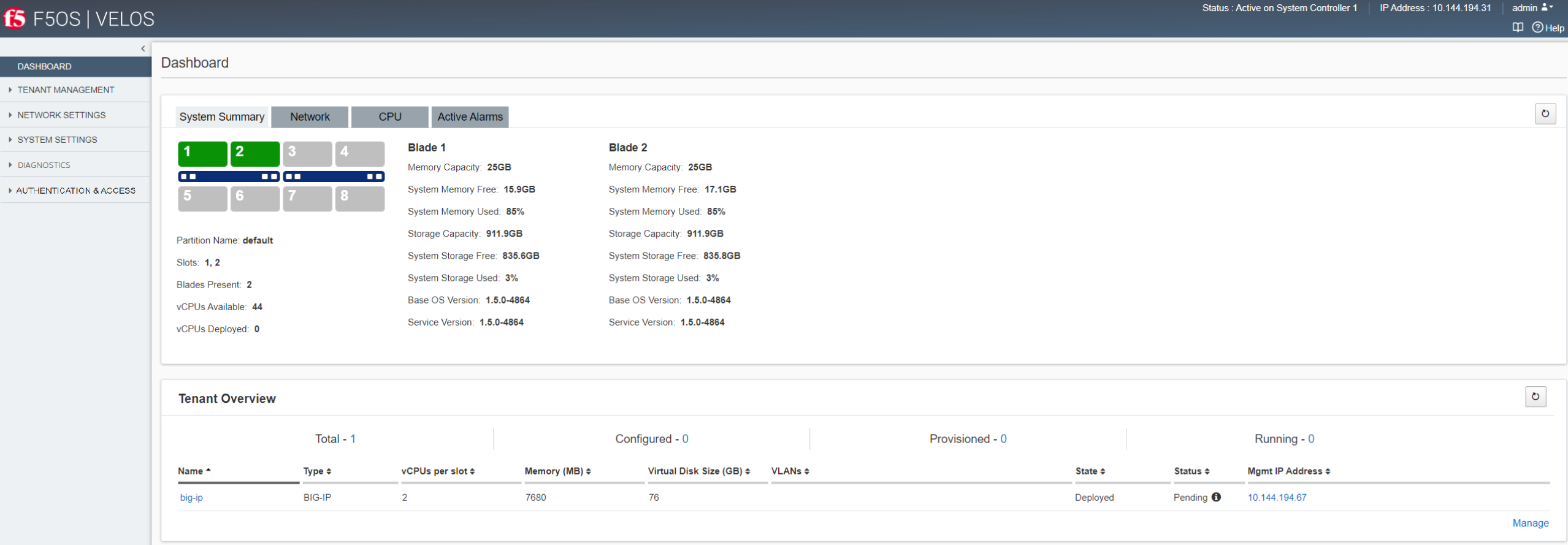
This chassis partition takes up slots 1 and 2 and uses 44 vCPUs. The details on the lower left summarize how many vCPUs are available, and how many are deployed and in use by the one tenant in that chassis partition.
The chassis partition dashboard includes these sections:
Shows system memory and storage data, and High Availability status. High availability status shows which system controller is currently active and whether the two controllers are both healthy. If both are healthy, the two system controllers handle traffic and are redundant, and the system is functioning normally.
Shows network interfaces (ports) speed and status for installed blades.
Shows information about CPU thread counts. Hovering over a bar in the graph displays utilization data for that thread. Use the dropdown menu to filter the display.
Shows system alerts that have occurred recently. The system updates the alarms every few seconds. It shows the source of the alert, its severity, a brief description of what occurred, and when it happened. If there is an active alarm, the Active Alarms tab will be in focus.
Lists an overview of tenant deployments in the chassis partition, the type, number of vCPUs in use by the tenant, memory data, virtual disk size, VLANs, state, status, and management IP addresses. Click a tenant name to view tenant deployment details. Click the IP address to open the login screen of the tenant in a new browser window. The Manage button lists all of the tenants on a separate screen, with paging if needed.