


Updated Date: 08/25/2026
Tenant Management
A tenant is a guest system running software in a chassis partition (for example, a BIG-IP system). VELOS systems support multitenancy, in that you can run several tenants in the same chassis partition, including BIG-IP and BIG-IP Next tenants. The maximum number of lightweight tenants that can be created in a blade is 22. Each blade has 128GB memory, of which 95GB is reserved for tenants. Each lightweight tenant requires a minimum of one vCPU and 4096MB minimum memory.
Note: Information about BIG-IP Next is available on my.f5.com, on clouddocs.f5.com, and in the article How to: Configure multi-tenancy for BIG-IP Next on VELOS.
The administrator can connect to the tenant’s webUI, CLI, or REST API and have the same experience as on their existing F5 platforms. A tenant on the VELOS platform is managed similarly to how a vCMP guest is managed today on the VIPRION platform. The tenant is assigned dedicated vCPU and memory resources and is restricted to specific VLANs for network connectivity.
The chassis partition administrator is responsible for configuring tenant deployments within the chassis partition. Once a tenant has been deployed, there is a per-tenant administrator role, whose responsibilities include configuring the services that are available on that tenant.
The admin is responsible for configuring tenant deployments within the appliance. Once a tenant has been deployed, there is a per-tenant administrator role, whose responsibilities include configuring the services that are available on that tenant.
Important: Tenants inherit certain capabilities, such as the license, VLANs, and management interface speed, from the chassis partitionsystem. Do not try to install a new license or delete the existing license on the tenants. Tenant admins cannot configure global partition-wide parameters. You configure these at the platform layer, and values are propagated to all tenants in the chassis partitionsystem.
Note: All tenant-level settings including virtual servers, pools, self IPs, VLAN properties, and traffic management must be configured after the tenant is deployed and running. For complete configuration procedures, refer to the F5 BIG-IP product documentation and K9412: The BIG-IP release matrix for your tenant software version.
Also see knowledge article Overview of the BIG-IP tenant image types
Note: Consider the following points while referring to the term slot:
- Scenario1: Here, the term slot refers to the number of boot locations inside a TMOS image. Images can be either single slot or dual slot. Single slot image has only one boot location and does not support in-place upgrades. Dual slot images will have 2 boot locations and supports in-place upgrades to different TMOS versions.
- Scenario 2: When deploying an F5OS tenant on VELOS, you can select the physical slots in the chassis that you want a tenant to run on. Here the term slot is used instead of the term blade, because you can pre-configure to run on a slot which does not have a blade installed yet.
This table lists tenant data specifications for VELOS systems.
This table lists tenant data specifications for VELOS systems.
| Tenant Size (vCPUs per tenant) | Physical Cores | Logical Cores (vCPU) | Minimum GB RAM | RAM/vCPU |
|---|---|---|---|---|
| BX110 blade with 1 vCPU/tenant | 0.5 | 1 | 4096 | 4096 |
| BX110 blade with 2 vCPU/tenant | 1 | 2 | 7680 | 3840 |
| BX110 blade with 4 vCPU/tenant | 2 | 4 | 14848 | 3712 |
| BX110 blade with 6 vCPU/tenant | 3 | 6 | 22016 | 3669.3 |
| BX110 blade with 8 vCPU/tenant | 4 | 8 | 29184 | 3648 |
| BX110 blade with 10 vCPU/tenant | 5 | 10 | 36352 | 3635.2 |
| BX110 blade with 12 vCPU/tenant | 6 | 12 | 43520 | 3626.6 |
| BX110 blade with 14 vCPU/tenant | 7 | 14 | 50688 | 3620.6 |
| BX110 blade with 16 vCPU/tenant | 8 | 16 | 57856 | 3616 |
| BX110 blade with 18 vCPU/tenant | 9 | 18 | 65024 | 3612.4 |
| BX110 blade with 20 vCPU/tenant | 10 | 20 | 72192 | 3609.6 |
| BX110 blade with 22 vCPU/tenant | 11 | 22 | 79360 | 3607.3 |
In this diagram, a VELOS CX410 chassis is divided into three chassis partitions (Red, Green, and Blue). These chassis partitions are completely isolated from each other, and the system controllers ensure that no traffic can jump from one chassis partition to another. After creating a chassis partition, you can deploy individual tenants. These tenants are restricted only to the resources within that chassis partition.
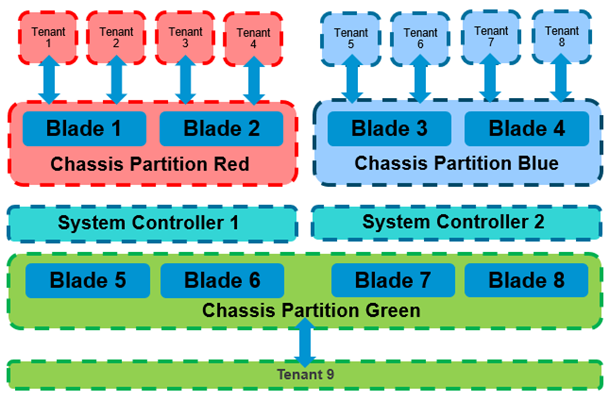
In the figure, the Red and Blue chassis partitions each span two blades and both have four tenants residing on them. The Green chassis partition spans four blades and has one tenant, Tenant 9, on it. Presumably, Tenant 9 is handling a large amount of traffic and requires more bandwidth and more processing power than the other tenants.
These BIG-IP tenant images are available to deploy on F5 VELOS systems:
- ALL-F5OS
- T4-F5OS
- T2-F5OS
- T1-F5OS (see note)
Note: T1-F5OS has limitations, so using the other images is recommended. Other images must be downloaded from F5 Downloads.
Each image type has different uses so you need to be sure to use the correct type for your tenant needs. For additional information about BIG-IP tenant image types, see K45191957: Overview of the BIG-IP tenant image types.
Important: Use the .tar.bundle format for all new F5OS tenant image deployments, as it replaces the deprecated .qcow2.zip.bundle format and supports PKI-based signature validation for enhanced security. Both formats produce functionally identical tenants, but only .tar.bundle supports future key rotations. For additional information, see K000158849: Differences Between .qcow2.zip.bundle and .tar.bundle Files for F5OS Tenant Images and F5 signing certificate and key rotation, October 2025.
Information about BIG-IP Next tenant image types is available on my.f5.com.
This table lists general use cases for BIG-IP tenant images. Information about BIG-IP Next tenant images is available on my.f5.com.
Each image has different sizing requirements. You will need to understand the size of the chassis partition and the tenant requirements to determine the number and type of tenants you can deploy. The amount of memory and disk space that a tenant actually needs is dependent on the number of modules provisioned and its use. This table provides information about BIG-IP tenant sizing. For information about BIG-IP Next tenant sizing, see my.f5.com.
This table lists general use cases for BIG-IP tenant images. Information about BIG-IP Next tenant images is available on my.f5.com.
|
Tenant image |
Description of Use |
|---|---|
|
ALL-F5OS |
* See the VELOS data sheet for all currently-supported features. |
|
T4-F5OS |
|
|
T2-F5OS |
|
|
T1-F5OS |
|
Each image has different sizing requirements. You will need to understand the size of the chassis partition and the tenant requirements to determine the number and type of tenants you can deploy. The amount of memory and disk space that a tenant actually needs is dependent on the number of modules provisioned and its use. This table provides information about BIG-IP tenant sizing. For information about BIG-IP Next tenant sizing, see my.f5.com.
| Tenant image | Disk size | Minimum memory | Minimum # vCPUs | Max tenants per blade |
|---|---|---|---|---|
| T1-F5OS | 22 GB | 4 GB | 1 | 22 |
| T2-F5OS | 45 GB | 8 GB | 2 | 11 |
| ALL-F5OS | 77/83/86 GB | 8 GB | 2 | 9 |
| T4-F5OS | 142 GB | 8 GB | 2 | 4 |
Important: The minimum virtual disk size for the tenant image category “ALL-F5OS” depends on the BIG-IP tenant image version you deploy. The minimum virtual disk size is 77 GB for BIG-IP 15.1.x tenant image, 83 GB for BIG-IP 17.1.x, BIG-IP 17.5.x, BIG-IP 21.0.x tenant image and 86 GB for BIG-IP 21.1.x tenant image on the BX110 blade. For additional information see K45191957: Overview of the BIG-IP tenant image types.
These are recommended resource considerations for determining the amount of memory (RAM) to allocate when planning tenant deployments on VELOS systems:
-
Each VELOS blade has up to 95GB of memory that can be allocated to tenants.
-
The minimum memory allocation for a tenant depends on the number of vCPUs requested.
-
This formula is used for default memory allocation
min-memory = (3.5 * 1024 * vcpu-cores-per-node) + 512 -
You can specify more than the minimum amount of memory when configuring a tenant, if needed.
These are some of the resource considerations for disk space when planning tenant deployments on VELOS systems:
- Each VELOS blade has approximately 600GB of disk storage available for tenants.
- The amount of disk space that a tenant actually needs is dependent on the number of modules provisioned and its use.
- As the aggregate disk usage within deployed tenants increases, the host disk can start to reach capacity on systems with many large tenants. The chassis partition administrator will need to monitor disk usage to make sure there is sufficient space for the tenants.
You can add or delete tenant images within a chassis partition from the chassis partition webUI. You must use HTTPS image import or export. Note that tenant images are specific to the VELOS system, and the software version must be compatible with it.
-
Log in to the VELOS chassis partition webUI using an account with admin access.
-
On the left, click TENANT MANAGEMENT > Tenant Images.
-
To upload an image, click Upload and browse to the image location.
-
To import an image:
-
Click Import.
A popup opens.
-
For URL, enter the URL of the remote image server.
F5 recommends that the remote host be an HTTPS server with PUT/POST enabled and have a valid CA-signed certificate. You can opt to select the Ignore Certificate Warnings check box if you want to skip the certificate check.
-
For Username, type the user name for an account on the remote image server, if required.
-
For Password, type the password for the account, if required.
-
Select Ignore Certificate Warnings to skip the certificate check.
-
Click Import Image.
Note: Depending on the image file size and network availability, the import might take a few minutes. If you want to cancel the in-progress file transfer operation, click Cancel. When the import is successful, the software image is listed in the webUI.
-
-
To delete a tenant image, select the image and click Delete. It is recommended that you wait 5-10 minutes after deleting a tenant before deploying another tenant.
After you have added the tenant images that you want to use to the chassis partition, you can create and deploy tenants that will use that software image. The tenant image must be one that is listed as compatible with the VELOS system.
Before you get started, be sure that you have already imported the tenant images that you want to use for the tenant deployments into the chassis partition. You need to know into which slots you want to deploy the tenant. You must also have previously created any required VLANs in the chassis partition. For more information, see Create VLANs from the webUI.
Before you can create and deploy tenants, you also need to estimate resource requirements so you know how many vCPUs, memory, and other options to assign to the tenant.
The chassis partition administrator can deploy tenants from the chassis partition webUI.
-
Log in to the VELOS chassis partition webUI using an account with admin access.
-
On the left, click TENANT MANAGEMENT > Tenant Deployments.
The Tenant Deployment screen displays showing the existing tenant deployments and associated details.
-
To add a tenant deployment, click Add.
The Add Tenant Deployment screen displays.
-
For Name, enter a name for the tenant deployment (up to 49 characters).
Note: The first character in the name cannot be a number. After that, only lowercase alphanumeric characters and hyphens are allowed.
-
For Type, select the tenant type: BIG-IP or BIG-IP Next.
If you select BIG-IP Next, the Deployment File field displays. Select the deployment file.
-
For Image, select the software image that was previously imported onto the system.
Ensure that the image you selected meets your tenant deployment needs.
-
For Allowed Slots, first select the appropriate option, and then select the slots (or blades) that you want the tenant to span from the list:
Option Description Partition Member Slots Lists only slots included in the chassis partition you are logged into. Any Slots Lists any slot on the chassis even if not associated with the chassis partition, and even if no blade is installed in that slot. You have the option of selecting slots 1-8 whether or not they are associated with the chassis partition. This enables you to preconfigure tenant deployments before the hardware is installed and before the chassis partition is configured to include it. -
For IP Address, enter the IPv4 address, IPv6 address, or Fully Qualified Domain Name (FQDN) for the tenant.
-
For Prefix Length, enter a number for the length of the prefix.
The maximum prefix length is 32 for IPv4 and 128 for IPv6.
-
For Gateway, enter the IPv4 address or IPv6 address of the gateway.
-
For VLANs, select one or more VLANs that are available to the tenant.
You can assign VLANs to more than one tenant in the same partition.
-
For MAC Data/MAC Block Size, select one of these options:
One
Represents a block with one MAC. This is used when l2-inline-device functionality is not needed. This is the default value.
Small
Represents a block of 8 MACs. When this value is used, the l2-inline-device is enabled, and the tenant gets a block of 8 contiguous MACs.
Medium
Represents a block of 16 MACs. When this value is used, the l2-inline-device is enabled, and the tenant gets a block of 16 contiguous MACs.
Large
Represents a block of 32 MACs. When this value is used, the l2-inline-device is enabled, and the tenant gets a block of 32 contiguous MACs.
-
For DAG IPv6 Prefix Length, enter the prefix length used by disaggregator algorithms.
The range is from 1 to 128, with a default value of 128.
For more information about the prefix length, see Configure DAG IPv6 prefix length from the CLI.
-
For Resource Provisioning, select one of these options:
Option Description Recommended Recommended values for vCPUs and memory for the tenant. Advanced Enables you to configure custom values for vCPUs and memory on the tenant. For example, if you want to configure a single vCPU tenant, or a tenant that uses more than the recommended amount of memory per slot. -
For vCPUs Per Slot, select the number of vCPUs to provide to the tenant.
The minimum recommended number of vCPUs per typical tenant is two (one vCPU is sufficient only for lightweight tenants that cannot be updated). Each blade has up to 22 vCPUs. The number of vCPUs needed depends on the amount of traffic the tenant will be handling. More vCPUs provide faster throughput.
-
For Memory Per Slot, specify the amount of RAM, in MB, to allocate to the tenant.
The amount of memory needed depends on the number of vCPUs assigned. The minimum amount of memory needed is determined by the formula
[(3.5 * 1024 * #ofvCPUs) + 512], so a two vCPU tenant needs a minimum of 7680 MB, and a four vCPU tenant needs a minimum of 14,848MB.If you do not allocate sufficient memory, you receive a warning message.
-
For Virtual Disk Size, specify the storage quota, in GB, for the tenant virtual disk.
The default size is 82 GB.
-
For State, select one of these options:
Options
Description
Configured
The tenant configuration exists on the chassis partition, but the tenant is not running, and no hardware resources (CPU, memory) are allocated to it. This is the initial state and the default.
Provisioned
Moves the tenant into the Provisioned state, which causes the system to install the software, assign the tenant to nodes, and create virtual disks for the tenant on those nodes. If you choose this option, it takes a few minutes to complete the provisioning. The tenant does not run while in this state.
Deployed
Changes the tenant to the Deployed state. The tenant is set up, resources are allocated to the tenant, the image is moved onto the blade, the software is installed, and after those tasks are complete, the tenant is fully deployed and running. If you choose this option, it takes a few minutes to complete the deployment and bring up the system. Note: Once a tenant is Deployed (and is up and running), changing its state back to Configured or Provisioned stops the tenant. You will receive a warning message before this occurs.
-
For Crypto/Compression Acceleration, select Enabled if the tenant requires high-performance crypto processing and compression.
When this option is enabled, the tenant receives dedicated crypto devices proportional to number of vCPU cores. Crypto processing and compression are off-loaded to the hardware. When the option is disabled, the tenant receives no crypto devices. This is not supported on BIG-IP Next.
-
To restrict usage of the Bash shell for tenant administrators, set Appliance Mode to Enabled (this is Disabled by default.)
-
Click Save & Close.
The tenant is now configured and in the Deployed state. When the status says Running, the tenant administrator can log in to the tenant webUI or CLI using the management IP address (with HTTPS or SSH) and continue configuring the tenant system.
Note: If the Status says Pending instead of Running, this may mean that there are not enough resources (vCPUs, memory, or other resources) for the tenant to be deployed. See the Tenant Details screen in the chassis partition webUI for more information about the specific tenant.
Depending on the state that the tenant is in, you can change certain tenant settings from the chassis partition webUI. The settings which cannot be modified will be grayed out.
-
Deployed: You can add or remove Allowed Slots or change the State only while tenants are active and running.
Note: Once a tenant is Deployed (and is up and running), changing its state back to Provisioned or Configured stops the tenant. You will receive a warning message before this occurs.
-
Provisioned: You can change all settings exceptImage.
-
Configured: You can change all settings except Image.
-
Log in to the VELOS chassis partition webUI using an account with admin access.
-
On the left, click TENANT MANAGEMENT > Tenant Deployments.
The Tenant Deployment screen displays showing the existing tenant deployments and associated details.
-
Click the name of the tenant deployment you want to modify.
The Tenant Deployment screen displays.
-
For Image, select a different software image to use for the tenant.
Note: Only BIG-IP Next Tenant image can be modifed when the tenant is in deployed state, which essentially upgrades the tenant
-
To update Allowed Slots, select the slots (or blades) that you want the tenant to span from the list.
-
You can change the IP Address, Prefix Length (1-32), and Gateway for the tenant, if in Configured or Provisioned state. Enter an IPv4 address or IPv6 address.
-
For VLANs, you can select different VLANs for the tenant, if in Configured or Provisioned state.
-
For Resource Provisioning, if changing resources, select either: Recommended (to use recommended values) or Advanced (to customize values), if in Configured or Provisioned state.
-
For vCPUs Per Slot, select the number of vCPUs for the tenant, if in Configured or Provisioned state.
The minimum recommended number of vCPUs per typical tenant is two (one vCPU is sufficient only for lightweight tenants that cannot be updated). Each blade has up to 22 vCPUs. The number of vCPUs needed depends on the amount of traffic the tenant will be handling. More vCPUs provide faster throughput.
-
For Memory Per Slot, specify the amount of RAM in MB to allocate to the tenant, if in Configured or Provisioned state.
The amount of memory needed depends on the number of vCPUs assigned. The minimum amount of memory needed is determined by the formula
[(3.5 * 1024 * #ofvCPUs) + 512], so a two vCPU tenant needs a minimum of 7680 MB, and a four vCPU tenant needs a minimum of 14,848MB. -
Change State (with caution!):
Option Description Configured If Deployed, this option stops the tenant from running, but maintains the configuration. Provisioned If Deployed, this option stops the tenant from running, but maintains the configuration. If Configured, causes the system to install the software, assign the tenant to nodes, and create virtual disks for the tenant on those nodes. The tenant does not run, consume resources, or pass traffic. Deployed Directly deploy the tenant. This sets up the tenant, allocates resources, moves the image onto the blade, and installs the software. When these tasks are complete, the tenant is fully deployed and running. -
Change Crypto/Compression Acceleration only if the tenant is in either the Configured or Provisioned state.
-
To restrict usage of the Bash shell for tenant administrators, set Appliance Mode to Enabled (this is Disabled by default.)
-
Click Save & Close.
The tenant is reconfigured according to the changes made.
You can enable appliance mode for deployed tenants from the chassis partition webUI.
Note: For greater security, consider configuring tenants to run in appliance mode.
-
Log in to the VELOS chassis partition webUI using an account with admin access.
-
On the left, click TENANT MANAGEMENT > Tenant Deployments.
The Tenant Deployment screen displays showing the existing tenant deployments and associated details.
-
Click the name of a tenant deployment.
-
Set Appliance Mode to Enabled.
-
Click Save.
Root or Bash access is disabled on the tenant. Users can still access the tenant from the webUI or the CLI.
You can monitor data and metrics related to the usage, performance, and behavior of the tenant from the webUI. These statistics are crucial for monitoring, managing, and optimizing the tenant. You can monitor the following tenant details:
- Tenant CPU Usage: Shows the measurement of CPU utilization by the tenant.
- Tenant Memory Usage: Shows the measurement of memory utilization by the tenant.
- Tenant Disk Usage: Shows the measurement of disk utilization by the tenant.
-
Log in to the VELOS chassis partition webUI using an account with admin access.
-
On the left, click TENANT MANAGEMENT > Tenant Details.
-
Select a tenant from the Tenant Name dropdown to see the tenant status and statistics.
You can now see the following statistics and status of the tenant.
- Tenant CPU Usage: Displays the tenant’s vCPU’s current utilization by default. However, if multiple vCPUs are available, you can select a vCPU and change the time series to view the historical data and analyze the vCPU utilization.
- Tenant Memory Usage: Displays the tenant’s current memory utilization by default. However, you can change the time series to view historical data and analyze memory utilization.
- Tenant Disk Usage: Displays the overall tenant disk current utilization by default. However, if you need the utilization stats of a specific disk, select the disk, data type, and change the time series to view the historical data and analyze the disk utilization.
- Tenant Status: Shows the overall status of the tenant image such as Node, Instance ID, Phase, Pod name, Creation time, Ready time, Status, and Management MAC details.
-
Select the interval from the Auto Refresh dropdown to refresh the data displayed or click the refresh icon to update the tenant data immediately.
Note: The utilization data does not depend on the refresh interval. It will continue to collect utilization statistics for the tenant regardless of the selected reload interval.
Use the tenants command from the chassis partition CLI to configure tenants on a chassis partition.
Before you get started, you might want to upload the tenant image you want to use to a local Linux server that uses HTTPS, so you can more easily import it to the VELOS system.
You can import a tenant image into a chassis partition from the CLI.
-
Log in to the command line interface (CLI) of the chassis partition using an account with admin access.
When you log in to the system, you are in user (operational) mode.
-
Import a tenant image to the chassis partition.
file import remote-port <*port-number*> username <*user*> password <*password*> remote-host <*ip-address-or-fqdn*> remote-file <*remote-file-path*> remote-url <*full-remote-url*> local-file imagesThis example imports a BIG-IP tenant image from server.company.com:
default-1(config)# file import username admin password remote-url
  https://server.company.com/images/BIGIP-1x.x.x-x.x.x.ALL-F5OS.qcow2.zip.bundle
  local-file images
Before you get started, be sure that you have already imported the tenant images that you want to use for the tenant deployments into the chassis partition. You need to know into which slots you want to deploy the tenant. You must also have previously created any required VLANs in the chassis partition. For more information, see Create VLANs from the CLI.
Before you can create and deploy tenants, you also need to estimate resource requirements so you know how many vCPUs, memory, and other options to assign to the tenant.
You can create and deploy tenants in a chassis partition from the CLI.
-
Log in to the command line interface (CLI) of the chassis partition using an account with admin access.
When you log in to the system, you are in user (operational) mode.
-
Change to config mode.
configThe CLI prompt changes to include
(config). -
Create and deploy the tenant.
tenants tenant <*tenant-name*> config <*options*>For more information about CLI options, see Tenant CLI command syntax.
This example creates a BIG-IP tenant named
velos-bigipthat spans two nodes and is in the Configured running state, by default:default-1(config)# tenants tenant velos-bigip config type BIG-IP image BIGIP-1x.x.x-x.x.x.ALL-F5OS.qcow2.zip.bundle mgmt-ip 192.0.2.200 prefix-length 24 gateway 192.0.2.254 nodes [ 1 2 ]For more information about DAG IPv6 prefix length, see Configure DAG IPv6 prefix length from the CLI.
-
Commit the configuration changes.
commit -
Monitor the operational state of the tenant and move the tenant into the provisioned state.
tenants tenant <*tenant-name*> config running-state provisionedThis example moves the tenant into the provisioned state, which causes the system to start and maintain VMs on each node to which the tenant is assigned.
default-1# tenants tenant velos-bigip config running-state provisionedThis causes the system to assign the tenant to nodes and create virtual disks for the tenant on those nodes.
-
Show the current status for the tenant:
show tenants tenant <*tenant-name*>When the system is creating the virtual disk and installing the image on a disk, the operational state of the tenant shows this information:
- PHASE – Allocating resources to the tenant is in progress
- status – Provisioning A summary similar to this example displays:
default-1# show tenants tenant velos-bigip
tenants tenant velos-bigip
 state unit-key-hash oa9gv8VYHcSoApv1234GQMn2uM9UzNKiDz78cIbqKv26LVjlIo9TCdp56z5UnXcVvr3hj0/ym2kbdWyBhPbkLA==
 state type          BIG-IP
 state image         BIGIP-bigip15.1.x-europa-15.1.5-0.0.222.ALL-F5OS.qcow2.zip.bundle
 state nodes         [ 1 2 ]
 state mgmt-ip       192.0.2.59
 state prefix-length 24
 state gateway       192.0.2.254
 state cryptos       enabled
 state vcpu-cores-per-node 2
 state memory        7680
 state storage size 76
 state running-state deployed
 state mac-data base-mac 00:94:a1:8e:70:0a
 state mac-data mac-pool-size 1
 state appliance-mode disabled
 state status        Provisioning
 state image-version "BIG-IP 15.1.5 0.0.222"
 state instances instance 1
  instance-id   1
  phase         Running
  image-name    BIGIP-bigip15.1.x-europa-15.1.5-0.0.222.ALL-F5OS.qcow2.zip.bundle
  creation-time 2022-12-01T19:56:49Z
  ready-time    2022-12-01T19:56:49Z
  status        "Allocating resources to tenant is in progress"
  mgmt-mac      f2:48:a7:f1:aa:ab
 state instances instance 2
  instance-id   2
  phase         Running
  image-name    BIGIP-bigip15.1.x-europa-15.1.5-0.0.222.ALL-F5OS.qcow2.zip.bundle
  creation-time 2022-12-01T19:56:50Z
  ready-time    2022-12-01T19:56:50Z
  status        "Allocating resources to tenant is in progress"
  mgmt-mac      f2:48:a7:f1:aa:ab
When the system completes the virtual disk creation, the operational state shows this information:
- PHASE – Ready to deploy
- status – Provisioned A summary similar to this example displays:
default-1# show tenants tenant velos-bigip tenants tenant velos-bigip state unit-key-hash oa9gv8VYHcSoApv1234GQMn2uM9UzNKiDz78cIbqKv26LVjlIo9TCdp56z5UnXcVvr3hj0/ym2kbdWyBhPbkLA== state type BIG-IP state image BIGIP-bigip15.1.x-europa-15.1.5-0.0.222.ALL-F5OS.qcow2.zip.bundle state nodes [ 1 2 ] state mgmt-ip 192.0.2.59 state prefix-length 24 state gateway 192.0.2.254 state cryptos enabled state vcpu-cores-per-node 2 state memory 7680 state storage size 76 state running-state deployed state mac-data base-mac 00:94:a1:8e:70:0a state mac-data mac-pool-size 1 state appliance-mode disabled state status Provisioned state image-version "BIG-IP 15.1.5 0.0.222" state instances instance 1 instance-id 1 phase "Ready to deploy" image-name BIGIP-bigip15.1.x-europa-15.1.5-0.0.222.ALL-F5OS.qcow2.zip.bundle creation-time "" ready-time "" status " " state instances instance 2 instance-id 2 phase "Ready to deploy" image-name BIGIP-bigip15.1.x-europa-15.1.5-0.0.222.ALL-F5OS.qcow2.zip.bundle creation-time "" ready-time "" status " " -
You can then deploy the tenant.
tenants tenant <*tenant-name*> config running-state deployedThis example moves the tenant into the deployed state, which causes the system to start and maintain VMs on each node to which the tenant is assigned.
default-1# tenants tenant velos-bigip config running-state deployed -
Commit the configuration changes.
commit -
You can check the status of the tenant.
show tenants tenant <*tenant-name*> state instancesA summary similar to this example displays:
default-1# show tenants tenant velos-bigip state instances
      INSTANCE
NODE  ID        PHASE    IMAGE NAME          CREATION TIME     READY TIME        STATUS                  MGMT...
----------------------------------------------------------------------------------------------------------------
1     1         Running  BIGIP-bigip15.1...  2022-12-01T23...  2022-12-01T23...  Started tenant instance ce:1...
2     2         Pending  BIGIP-bigip15.1...  2022-12-01T23...  2022-12-01T23...  Started tenant instance 22 5..
After you configure and deploy the tenant, and the Status is updated to Running, then you can use the management IP address to access the tenant system using SSH, the web-based Configuration utility, or TMOS Shell (tmsh).
Note: Once a tenant is Deployed (and is up and running), changing its state back to Configured or Provisioned stops the tenant. You will receive a warning message before this occurs.
Note: If the Status is Pending instead of Running, this might mean that there are not enough resources (vCPUs, memory, or other resources) for the tenant to be deployed. See the Tenant Details screen in the chassis partition webUI for more information about the specific tenant.
You can configure the DAG IPv6 prefix length from the chassis partition CLI. DAG IPv6 prefix length is a configuration field on each tenant that is used by disaggregator algorithms as a networking mask. The valid configuration value is from 1 to 128. The default value is 128. You can configure the value from either the chassis partition or the tenant.
When you configure the value at the chassis partition level, it is pushed automatically to the tenant. When you configure the prefix length at the tenant level, future configuration at the chassis partition level is disabled and must be re-enabled from the tenant.
-
Log in to the command line interface (CLI) of the chassis partition using an account with admin access.
When you log in to the system, you are in user (operational) mode.
-
Change to config mode.
configThe CLI prompt changes to include
(config). -
Configure DAG IPv6 prefix length while creating a tenant.
This propagates the value to the tenant. For more information, see Create and deploy tenants from the CLI.
-
Configure DAG IPv6 prefix length from the system after the tenant is created.
This propagates the value to the tenant.
tenants tenant <*tenant-name*> config dag-ipv6-prefix-length <value>This example changes the DAG IPv6 prefix length of a tenant named “velos-bigip” to 120.
default-1(config)# tenants tenant velos-bigip config dag-ipv6-prefix-length 120 -
Commit the configuration changes.
commit
If you configure the DAG IPv6 prefix length, but the value is not propagated to the tenant, you might have previously configured this value externally (such as from the tenant’s webUI, CLI, or REST APIs). This disables configuration at the chassis partition level. On a BIG-IP tenant, run this command sequence to re-enable configuration:
tmsh mod sys db dag.userconfigipv6prefixlen value falseYou can display detailed information about tenants configured in a chassis partition from the chassis partition CLI.
-
Log in to the command line interface (CLI) of the chassis partition using an account with admin access.
When you log in to the system, you are in user (operational) mode.
-
Show the tenants that are currently configured in a chassis partition.
show tenantsThis example displays the operational data for a BIG-IP tenant spanning two blades. It uses one VLAN, no cryptos, two vCPU cores, and appliance mode is not enabled. The Instance table in the output displays the live health of the tenant running on the VELOS system.
default-1# show tenants tenant bigip tenants tenant bigip state unit-key-hash oa9gv8VYHcSoApv1234GQMn2uM9UzNKiDz78cIbqKv26LVjlIo9TCdp56z5UnXcVvr3hj0/ym2kbdWyBhPbkLA== state type BIG-IP state image BIGIP-bigip15.1.x-europa-15.1.5-0.0.222.ALL-F5OS.qcow2.zip.bundle state nodes [ 1 ] state mgmt-ip 192.0.2.59 state prefix-length 24 state gateway 192.0.2.254 state cryptos enabled state vcpu-cores-per-node 2 state memory 7680 state storage size 76 state running-state deployed state mac-data base-mac 00:94:a1:8e:70:0a state mac-data mac-pool-size 1 state appliance-mode disabled state status Running state primary-slot 1 state image-version "BIG-IP 15.1.5 0.0.222" state instances instance 1 instance-id 1 phase Running image-name BIGIP-bigip15.1.x-europa-15.1.5-0.0.222.ALL-F5OS.qcow2.zip.bundle creation-time 2021-12-01T19:56:49Z ready-time 2021-12-01T19:56:35Z status "Started tenant instance" mgmt-mac f2:48:a7:f1:aa:ab -
Show the running configuration of the tenants.
show running-config tenants tenantA summary similar to this example displays:
default-1# show running-config tenants tenant
tenants tenant bigip
 config type         BIG-IP
 config image        BIGIP-bigip15.1.x-europa-15.1.5-0.0.222.ALL-F5OS.qcow2.zip.bundle
 config nodes        [ 1 2 ]
 config mgmt-ip      192.0.2.59
 config prefix-length 24
 config gateway      192.0.2.254
 config cryptos      enabled
 config vcpu-cores-per-node 2
 config memory       7680
 config storage size 76
 config running-state deployed
 config appliance-mode disabled
You can monitor data and metrics related to the usage, performance, and behavior of a tenant from the CLI. These statistics, tenant CPU usage, memory usage, and disk usage, are crucial for monitoring, managing, and optimizing the tenant.
-
Log in to the command line interface (CLI) of the chassis partition using an account with admin access.
When you log in to the system, you are in user (operational) mode.
-
Change to config mode.
configThe CLI prompt changes to include
(config). -
Show tenants status and statistics.
tenants tenant <*tenant name*> state <*action*>This example displays the tenant status and statistics for a BIG-IP tenant running on the system.
Note: You can get the stats with an average of 10 seconds, 30 seconds, 1 minute, 5 minutes, and 10 minutes.
-
For CPU stats:
default-1(config)# tenants tenant cbip state cpu-thread-stats average 1m-avg averages { unix-seconds 1717588320 cpu-threads { cpu-thread { thread-index 0 busy-percent 1 } cpu-thread { thread-index 1 busy-percent 0 } cpu-thread { thread-index 2 busy-percent 0 } cpu-thread { thread-index 3 busy-percent 4 } cpu-thread { thread-index 4 busy-percent 4 } cpu-thread { thread-index 5 busy-percent 4 } cpu-thread { thread-index 6 busy-percent 4 } cpu-thread { thread-index 7 busy-percent 12 } cpu-thread { thread-index 8 busy-percent 4 } cpu-thread { thread-index 9 busy-percent 1 } cpu-thread { thread-index 10 busy-percent 4 } cpu-thread { thread-index 11 busy-percent 4 } cpu-thread { thread-index 12 busy-percent 4 } default-1(config)# -
For disk stats:
default-1(config)# tenants tenant cbip state disk-stats average 1m-avg averages { unix-seconds 1717588260 used-percent 88 disk-list { disk { disk-name nvme0n1 total-iops 0 read-iops 0 read-bytes 148 write-iops 154 write-bytes 1691163 } } } default-1(config)# -
For interface stats:
default-1(config)# tenants tenant cbip state interface-stats average 1m-avg averages { unix-seconds 1717588380 interface-list { interface { interface-name 1.0 ifc-bytes-in 1466 ifc-bytes-out 0 ifc-packets-in 0 ifc-packets-out 0 } interface { interface-name 2.0 ifc-bytes-in 135 ifc-bytes-out 0 ifc-packets-in 0 ifc-packets-out 0 } } } default-1(config)# -
For memory stats:
default-1(config)# tenants tenant cbip state memory-stats average 1m-avg
averages {
        unix-seconds 1717588440
        available 8493508881
        free 1060426615
        used-percent 93
        platform-total 16107667456
        platform-used 8114811835
    }
default-1(config)#
-
You can modify a tenant configured in a chassis partition from the chassis partition CLI.
The administrator is able to modify only these fields while the tenant is running:
- running-state
- vlans
- nodes
-
Log in to the command line interface (CLI) of the chassis partition using an account with admin access.
When you log in to the system, you are in user (operational) mode.
-
Show configuration information for the tenant you want to update.
show tenants tenant <*name*> -
Change to config mode.
configThe CLI prompt changes to include
(config). -
You can modify these options while the tenant is running: vlans, nodes, or running-state.
tenants tenant <*name*> config { vlans <*vlan-id*> | nodes { 1 2 } | running-state { configured | provisioned | deployed } ] -
To modify any of the other options, first change the running state of the tenant to provisioned.
tenants tenant <*name*> config running-state provisionedMake desired changes. For more information, see the Tenant CLI command syntax section.
-
Commit the configuration changes.
commit
You can resize the storage quota for a tenant virtual disk from the chassis partition CLI.
-
Log in to the command line interface (CLI) of the chassis partition using an account with admin access.
When you log in to the system, you are in user (operational) mode.
-
Display configuration information for the tenant you want to update.
show tenants tenant <*name*> -
Change to config mode.
configThe CLI prompt changes to include
(config). -
Change the storage quota, in GB, for the virtual disk for a specified tenant.
The default size is 77 GB.
tenants tenant bigip-vm config storage size 80Note: You cannot modify the size of the virtual disk when the tenant is in the deployed running-state. The storage size can be modified only when the tenant is in a configured or provisioned running state.
-
Commit the configuration changes.
commit
You can delete tenant configurations in a chassis partition from the chassis partition CLI. It is recommended that you wait 5-10 minutes after deleting a tenant before deploying another tenant.
-
Log in to the command line interface (CLI) of the chassis partition using an account with admin access.
When you log in to the system, you are in user (operational) mode.
-
Show the tenants that are currently configured in that chassis partition to check the names of the tenants.
show tenants -
Change to config mode.
configThe CLI prompt changes to include
(config). -
Remove a tenant configuration from the chassis partition.
no tenants tenant <*tenant-name*> -
Commit the configuration changes.
commit
The tenant deployment is removed from the chassis partition.
Use the tenants command from the chassis partition CLI to configure tenants on a chassis partition.
The tenant command includes this syntax and these options:
tenants tenant <*options*>|
Option |
Value |
Description |
|---|---|---|
|
appliance-mode |
enabled or disabled (default) |
When enabled, appliance-mode disallows root and Bash access for the tenant. |
|
dag-ipv6-prefix-length |
Decimal value |
Tenant default value of IPv6 networking mask used by disaggregator algorithms. |
|
cryptos |
enabled or disabled (default) |
Specifies the crypto device support for the tenant. When enabled, the tenant receives dedicated crypto devices proportional to the number of vCPU cores. When disabled, the tenant receives no crypto device support. |
|
gateway |
IP address |
Specifies the IPv4 IPv6 address of the default gateway for the management network. This IP address can be changed on the tenant itself. This field is required. |
|
image |
Image name for the tenant |
Specifies which software image to install on newly created virtual disks for this tenant. This field is required. |
|
mac-data |
Available options are: - one - Represents a block with one MAC.
|
Specifies configuration data for MAC block size per tenant. |
|
memory |
Number in MB; 3840 MB is the minimum required per vCPU core or |
Specifies the memory in MBs for the tenant. For the commit to succeed, tenant configuration requires the minimum MBs required depending on the number of cores specified for the tenant. For example, for 2 vCPU cores, the minimum amount of memory is 7680 MB. The administrator must decide the amount of dedicated memory needed to satisfy the requirements of the BIG-IP or BIG-IP Next modules that will be provisioned within the tenant.Note: The maximum amount of memory available per blade is 102400 MB. |
|
mgmt-ip |
IP address |
Specifies the management IP address to the tenant. This address floats to the primary node of the tenant. The address can be changed on the tenant. This field is required. |
|
nodes |
Node numbers in square brackets separated by a space. For example, [1 2] |
Lists the nodes that the tenant can be assigned to. This field is required. Specifies the nodes on the chassis partition on which to provision the tenant. Though you can specify nodes that are not part of the chassis partition, the tenant will not be provisioned until the resources are included in the chassis partition. |
|
prefix-length |
Decimal value |
Specifies the prefix length of the management network. This field is required. |
|
running-state |
Configured (default), provisioned, or deployed |
Specifies the state of a tenant: configured, provisioned, or deployed. Tenants are put in the configured state by default. Configured means the tenant exists on partition, but the tenant has no hardware resources (CPU or memory) allocated to it and it is not running. When the tenant is provisioned, the system assigns the tenant to nodes and creates virtual disks for the tenant on those nodes. In the deployed state, allocated resources are used to launch the tenant VM. Note that, specifying deployed causes the actions that occur in the configured and provisioned states. To shut down the tenant VM without removing the virtual disk, change the running state from deployed to provisioned. Changing the tenant running-state to configured from provisioned or deployed causes its virtual disk to be deleted. |
|
storage |
Storage quota in GB for the tenant |
Specifies how much storage quota a tenant is allocated. The default size is 77 GB. You cannot modify the size of the virtual disk when the tenant is in the deployed running-state. You can modify the storage size when the tenant is in configured or provisioned running-states. For information on determining minimum disk size, see [Tenant sizing](Tenant sizingtitle-tenant-management.dita#tenant-sizing). |
|
type |
BIG-IP (default), BIG-IP Next, or other supported tenant type |
Specifies the supported tenants on the VELOS system. |
|
vcpu-cores-per-node |
Decimal number |
Specifies how many cores a tenant is allocated from each node that it is assigned to. Use tab completion to see a list of possible values on the current VELOS system. The default value is 2 |
|
virtual-wires |
Virtual wire name |
User-specified virtual-wires from virtual-wire table for the tenant. |
|
vlans |
VLAN ID |
Specifies the VLAN ID to be used for tenant traffic. To process the traffic through the tenant, make sure the VLAN is configured on the chassis partition. |
VELOS chassis partitions include a tenant console user that provides console access to tenants from the chassis partition’s management IP address.
The system creates the tenant console user account by default when you create a tenant, but the account is expired and has no password. Before you can access the tenant console, you must first unlock the tenant console user from the CLI.
-
Log in to the command line interface (CLI) of the chassis partition using an account with admin access.
When you log in to the system, you are in user (operational) mode.
-
Show information about configured users.
show system aaa authentication usersA summary similar to this example displays:
default-1# show system aaa authentication users
             LAST    TALLY  EXPIRY
USERNAME     CHANGE  COUNT  DATE    ROLE
----------------------------------------------------
admin        19370   0      -1      admin
big-ip       0       0      1       tenant-console
root         0       0      -1      root
The expiration date for the tenant console user is 1, which indicates that the user account is locked. The admin and root accounts are enabled (-1), and there are no disabled (0) accounts.
-
Change to config mode.
configThe CLI prompt changes to include
(config). -
Set a password for the tenant console user.
system aaa authentication users user <*tenant-name*> config set-password passwordThis example sets a password for a specified tenant console user:
default-1(config)# system aaa authentication users user big-ip config set-password password Value for 'password' (<string>): ********* -
Set an expiration date for the tenant console user.
system aaa authentication users user <*tenant-name*> config expiry-date -1This example enables the specified tenant console user:
default-1(config)# system aaa authentication users user big-ip config expiry-date -1 -
Commit the configuration changes.
commit -
Verify that the tenant console user is enabled and unlocked.
show system aaa authentication usersA summary similar to this example displays:
default-1# show system aaa authentication users
             LAST    TALLY  EXPIRY
USERNAME     CHANGE  COUNT  DATE    ROLE
----------------------------------------------------
admin        19370   0      -1      admin
big-ip       19389   0      -1      tenant-console
root         0       0      -1      root
Before you can connect to a tenant console, your user account must have terminal access enabled. On BIG-IP tenants this is disabled by default.
The system creates the tenant-console user account by default when you create a tenant, but the account is expired and has no password. Before you can access the tenant console, you must first unlock the tenant-console user from the CLI.
-
Log in to the command line interface (CLI) of the chassis partition using an account with admin access.
When you log in to the system, you are in user (operational) mode.
-
View the instance identifier for a specified tenant on the chassis partition.
show tenants tenant <*tenant-name*> state instancesA summary similar to this example displays:
default-1# show tenants tenant big-ip state instances state instances instance 1 big-ip instance-id 1 phase Running creation-time 2023-01-31T12:30:28Z ready-time 2023-01-31T12:30:55Z status "Started tenant instance" mgmt-mac ca:c3:7d:64:30:7e -
Connect using SSH to the tenant console, using the name of the tenant as the SSH username.
ssh <*tenant-name*>@<*chassis-partition-ip*> -p 700<*instance-id*>In this example, you connect to a tenant named “big-ip” at a specified chassis partition IP address, where
-p 7001indicates the instance identifier for the tenant:ssh big-ip@192.0.2.76 -p 7001 -
Log in to the tenant console.
Note: The default login password is default.
jdoe@SEA-00012345:~$ ssh big-ip@192.0.2.76 -p 7001 big-ip@192.0.2.76's password: Successfully connected to big-ip console. The escape sequence is ^] -
Log in to the tenant using your configured credentials.
BIG-IP 17.1.0 Build 0.0.1599
Kernel 3.10.0-862.14.4.el7.x86_64 on an x86_64
big-ip login:
If you are unable to log in, verify that your user has terminal access enabled. This is disabled by default on BIG-IP tenants.
You can configure tenants for high-availability (HA) on an VELOS system similar to how it is done on a BIG-IP system or for vCMP guests. To implement high-availability, you set up device service clustering or DSC. DSC provides synchronization and failover of BIG-IP configuration data and traffic groups on two or more tenants. The tenant administrator sets up DSC on the tenants.
For information on BIG-IP Next tenant configuration, see my.f5.com.
While you can set up HA for two tenants in two different chassis partitions on the same chassison the same system, it is not recommended. Mirroring is not supported on the same chassissystem. It is recommended that you set up HA for tenants in chassis partitions on two different chassison two different systems.
If you plan to set up mirroring, you must use an additional chassissystem. Connection mirroring requires that both VELOS systems have identical hardware platforms(chassis and blades). Also, each chassis within the Sync-Failover device group must contain the same number of blades in the same slot numbers.
Important: Tenants must have identical resources to ensure seamless HA failover. F5 does not support HA between tenants on disparate platforms.
For more information, see these guides at K000130285: F5 Product Manuals Index:
Before you begin, you must set up two VELOS systems with initial configuration, management IP addresses, gateways, DNS servers, and licensing. For more information, see VELOS Systems: Software Installation and Upgrade and other sections in this guide.
Note: For information about configuring high availability (HA) for BIG-IP Next tenants, see my.f5.com.
You can set up high availability for two BIG-IP tenants in chassis partitions that reside on two separate systems.
-
Log in to the chassis and create at least one chassis partition on both VELOS systems.
-
Log in to the chassis partition on each chassis and deploy a BIG-IP tenant.
Note: Make sure that both tenants are running the same BIG-IP software version and that it is compatible with VELOS systems.
-
On the tenants, set up L2 network connectivity between the two tenants including setting up VLANs and self-IPs for ConfigSync, failover, and mirroring.
For example, create the same VLAN on both tenants with management IP addresses that can communicate with each other.
-
Log in to each tenant and set the failover ConfigSync address to the self IP addresses on both sides.
-
Establish device trust: On one of the tenants, go to Device Management > Device Trust, create a device trust, and add the management IP of the other tenant.
-
Create a Sync-Failover device group: On the tenants, go to Device Management > Device Group and create a device group with the Group Type option set to Sync-Failover.
For more information, see the “Working with Device Groups” section in BIG-IP Device Service Clustering: Administration at K000130285: F5 Product Manuals Index).
-
On the tenants, go to Device Management > Devices, select the device and initiate the first ConfigSync manually.
After setting up HA for tenants, you can optionally create traffic groups, enable mirroring on the virtual servers, and sync the configurations.
Understand that there are many ways to configure HA, and this summary explains the general work flow for how to approach tenant HA. Your environment might require additional steps.